
The Urgent Need for AI-Ready M&E and MEAL Professionals
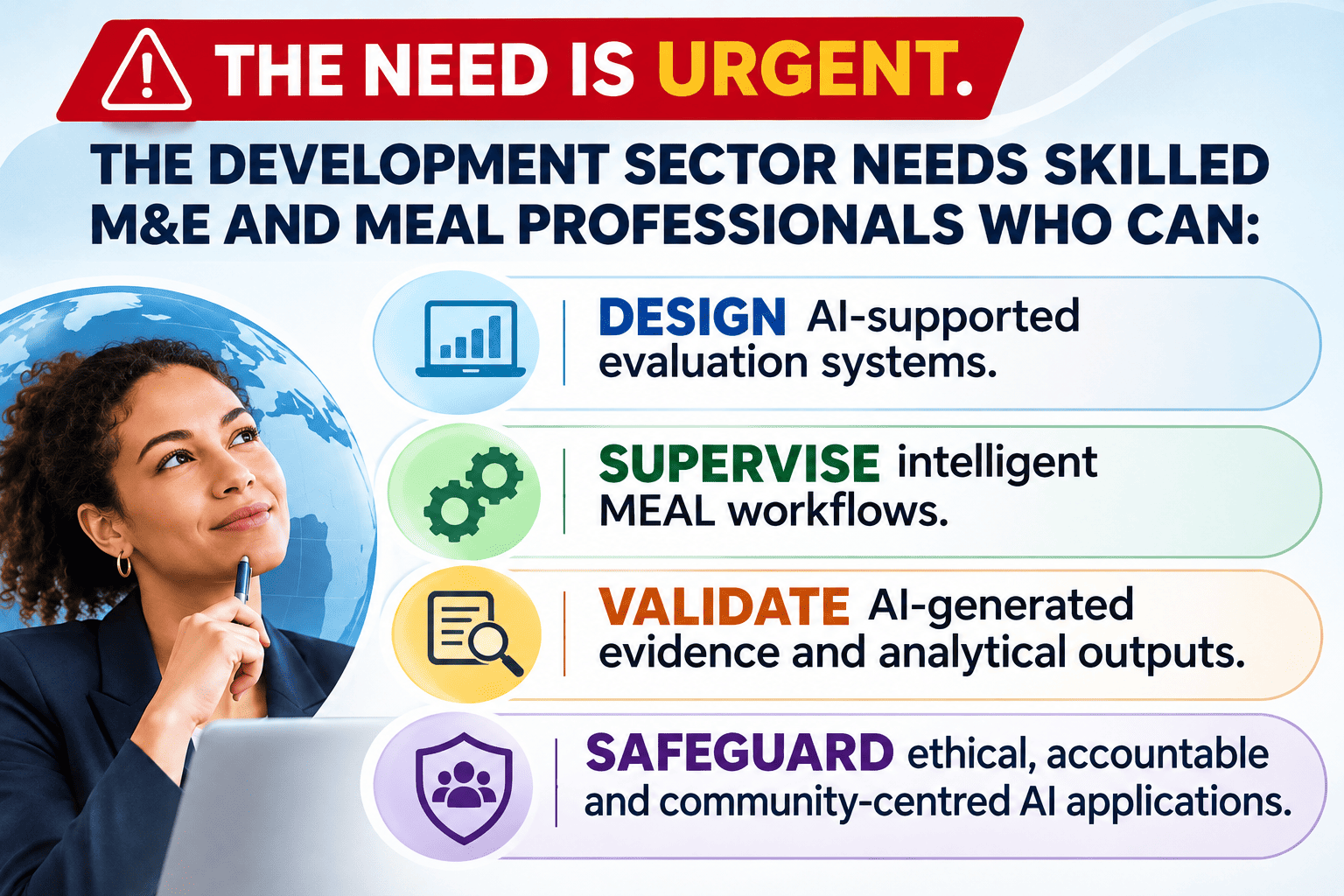
The need is urgent. The development sector needs skilled M&E and MEAL professionals who can design, supervise, validate and safeguard AI applications.
As artificial intelligence becomes increasingly integrated into development programmes, organisations need professionals who can ensure that these technologies are useful, reliable, ethical and accountable.
The Urgent Need for AI-Ready M&E and MEAL Professionals: Four Critical Responsibilities Shaping the Future of International Development
Artificial Intelligence is entering the development sector. But who will ensure that it is designed, supervised, validated and used responsibly?
Artificial Intelligence (AI) is transforming how international development organisations operate. From programme design and monitoring to evaluation, research, data management and reporting, AI-powered technologies are creating new possibilities for improving efficiency, strengthening evidence and supporting decision-making.
However, the growing adoption of AI also introduces an important challenge.
Organisations do not simply need access to AI technologies. They need qualified professionals who understand how to apply these technologies within the complex realities of development programmes.
They need people who understand evaluation methodologies, results frameworks, indicators, research ethics, accountability, data quality and the communities these programmes serve.
The need is urgent. The development sector needs skilled M&E and MEAL professionals who can take on four increasingly important responsibilities.
1. DESIGN: AI-Supported Evaluation Systems
AI can support many stages of the evaluation process, from reviewing programme documentation and organising evidence to analysing data, identifying patterns and preparing analytical reports.
But effective AI-supported evaluation systems do not happen automatically.
They require professionals who understand evaluation design, theories of change, logical frameworks, indicators, evaluation questions, methodologies and standards of evidence.
M&E professionals will increasingly need to contribute to designing systems that combine established evaluation approaches with appropriate AI capabilities.
Potential responsibilities include:
- Designing AI-supported monitoring and evaluation workflows.
- Developing AI-assisted indicator monitoring systems.
- Integrating AI into results-based management frameworks.
- Designing automated data analysis and reporting processes.
- Developing specialised AI tools for evaluation and research.
- Ensuring that AI-supported systems remain methodologically sound.
For example, an evaluation specialist could help design an AI-supported system that analyses programme monitoring data, identifies unusual patterns and generates preliminary insights for human review.
The technology can accelerate the analytical process, but the evaluator remains responsible for methodological decisions and the interpretation of findings.
The emerging opportunity
M&E professionals who can translate evaluation requirements into practical AI-supported systems.
2. SUPERVISE: Intelligent MEAL Workflows
MEAL systems generate significant amounts of information through monitoring activities, community feedback mechanisms, beneficiary surveys, complaints systems and learning processes.
AI agents and automated workflows can help organisations process this information more efficiently.
For example, AI-powered systems can assist with:
- Categorising beneficiary feedback.
- Organising qualitative information.
- Identifying recurring themes in community responses.
- Supporting complaints and feedback analysis.
- Preparing preliminary monitoring summaries.
- Identifying potential anomalies in programme data.
- Supporting organisational learning and knowledge management.
However, automation introduces a new responsibility: supervision.
Who checks whether an AI agent has classified feedback correctly? Who identifies inappropriate interpretations? Who ensures that sensitive beneficiary information is protected? Who determines when an automated workflow should be stopped or reviewed?
These responsibilities require professionals who understand both MEAL processes and the limitations of AI systems.
Potential professional specialisations include:
- AI-Enabled MEAL Specialist.
- Intelligent Workflow Supervisor.
- AI-Assisted Accountability Specialist.
- AI-Enhanced Learning and Knowledge Management Specialist.
- Human Oversight and AI Operations Specialist.
The emerging opportunity
MEAL professionals who can supervise AI-assisted operations while maintaining accountability, quality and human oversight.
3. VALIDATE: AI-Generated Evidence and Analytical Outputs
AI can generate summaries, identify patterns, produce analytical interpretations and support the preparation of evaluation reports.
But generating information is not the same as generating reliable evidence.
AI systems can produce inaccurate interpretations, overlook important contextual information, misrepresent qualitative findings or generate conclusions that are not adequately supported by the available data.
This makes validation one of the most important responsibilities in AI-enabled M&E.
Professionals will need to assess whether AI-generated outputs are:
- Accurate and consistent with the original data.
- Supported by credible evidence.
- Methodologically appropriate.
- Free from significant analytical errors.
- Representative of the information being analysed.
- Sensitive to contextual and cultural considerations.
- Appropriate for the decisions they are intended to inform.
Consider an AI-assisted qualitative analysis system that identifies themes across hundreds of beneficiary interviews.
The system may identify recurring patterns, but an experienced qualitative researcher must assess whether the themes are meaningful, whether important perspectives have been overlooked and whether the interpretations accurately reflect participants’ experiences.
Similarly, AI-generated evaluation reports must be reviewed against the underlying evidence, methodology and evaluation standards.
Potential professional specialisations include:
- AI Quality Assurance Analyst.
- AI-Assisted Evaluation Specialist.
- Evidence Validation Specialist.
- AI Research and Data Validation Specialist.
- Responsible AI Evaluation Consultant.
The emerging opportunity
Experienced evaluators, researchers and data specialists who can validate AI-generated evidence and maintain the credibility of evaluation findings.
4. SAFEGUARD: Ethical, Accountable and Community-Centred AI
International development programmes frequently work with vulnerable populations, sensitive personal information and complex social environments.
Introducing AI into these contexts requires particular attention to ethics, accountability, transparency and human rights.
An AI system may be technically effective but still create risks if it reproduces bias, exposes sensitive information, excludes certain groups or produces decisions that negatively affect beneficiaries.
For this reason, responsible AI adoption must become an integral part of programme management, monitoring and evaluation.
Professionals will increasingly need to contribute to:
- Assessing risks associated with AI applications.
- Protecting sensitive programme and beneficiary data.
- Identifying potential algorithmic bias.
- Establishing human oversight mechanisms.
- Ensuring transparency in AI-supported decisions.
- Maintaining accountability to affected communities.
- Assessing the implications of AI-generated recommendations.
- Ensuring that AI applications respect established ethical standards.
For example, an organisation using AI to analyse beneficiary feedback must consider whether the system accurately represents different groups, protects respondents’ identities and avoids producing misleading conclusions about community needs.
These responsibilities cannot be delegated entirely to technology providers.
They require people who understand development ethics, evaluation principles, accountability mechanisms and the potential consequences of decisions affecting communities.
Potential professional specialisations include:
- Responsible AI and Evaluation Specialist.
- AI Governance and Accountability Specialist.
- AI Ethics and Quality Assurance Officer.
- AI Risk and Compliance Specialist.
- Digital Accountability Specialist.
The emerging opportunity
M&E and MEAL professionals who can connect responsible AI governance with the ethical realities of international development.
Why M&E and MEAL Professionals Are Essential to This Transition
A common misconception is that AI-related career opportunities are primarily reserved for programmers, software engineers and data scientists.
Technical expertise is important, but it is not sufficient.
An AI developer may know how to build an automated evaluation tool. However, understanding what should be measured, which indicators are appropriate, how evidence should be interpreted and whether the findings are methodologically credible requires specialised M&E knowledge.
Similarly, developing an AI-powered beneficiary feedback system requires more than technical implementation. It requires understanding accountability, participation, safeguarding, confidentiality and the realities of community engagement.
This is where experienced M&E and MEAL professionals bring significant value.
Their existing professional knowledge provides a foundation for working with AI technologies in ways that are relevant, methodologically appropriate and responsible.
The opportunity is not necessarily to replace traditional M&E competencies with technical skills. It is to combine them.
Four Responsibilities, New Professional Opportunities
These four responsibilities also point towards a broader transformation of professional roles across the development sector.
Four Emerging Areas of Responsibility
| DESIGN | AI-supported M&E systems and evaluation design |
| SUPERVISE | Intelligent MEAL workflows and AI operations |
| VALIDATE | AI quality assurance and evidence validation |
| SAFEGUARD | Responsible AI, governance and accountability |
Professionals may specialise in one area or combine several responsibilities depending on their experience, interests and organisational needs.
These are emerging professional directions rather than a claim that every organisation has already established dedicated positions for them.
Nevertheless, understanding these responsibilities can help professionals prepare for changing organisational requirements and identify potential career pathways.
What Should M&E Professionals Do Now?
Preparing for this transition does not mean learning every AI application available on the market.
It means developing practical competencies that complement existing professional expertise.
1. Understand AI Fundamentals
Learn how generative AI, machine learning and AI agents work. Understand their capabilities, limitations and potential applications in development programmes.
2. Develop AI-Assisted Research and Evaluation Skills
Explore how AI can support qualitative analysis, thematic coding, literature reviews, data analysis, evidence synthesis and reporting.
3. Learn to Design and Supervise AI Workflows
Understand how to integrate AI into existing M&E and MEAL processes, develop automated workflows and maintain human oversight.
4. Strengthen Data and Analytical Competencies
Develop practical skills in data management, Excel, Power BI, data visualisation and analytical interpretation.
5. Understand Responsible AI and Quality Assurance
Learn how to validate AI outputs, identify bias, protect sensitive information and maintain ethical and professional accountability.
The objective is not to become an expert in everything. It is to develop the competencies needed to work effectively alongside AI technologies.
The Future of M&E Requires More Than AI Adoption
The international development sector is entering a period of significant technological change.
AI will influence how organisations collect information, analyse evidence, monitor programmes, conduct evaluations and make decisions.
But technology alone cannot guarantee better development outcomes.
The sector needs professionals who can ensure that AI applications are useful, accurate, transparent, ethical and accountable.
It needs evaluators who can design AI-supported systems.
It needs MEAL specialists who can supervise intelligent workflows.
It needs researchers who can validate AI-generated evidence.
And it needs experienced development professionals who can safeguard the interests of the communities these technologies are intended to serve.
The question is no longer simply whether organisations will adopt AI. The question is whether the sector is preparing enough qualified professionals to ensure that AI is used effectively and responsibly.
The transition has already become an important professional development priority.
The time to prepare is now.
Continue Your AI Learning Journey with EvalCommunity Academy
At EvalCommunity Academy, we believe that M&E and international development professionals should not simply observe the AI transformation. They should develop the knowledge and practical competencies to participate in it.
Our AI learning programmes are designed to help professionals understand AI applications, strengthen their analytical capabilities and explore how emerging technologies can be integrated into monitoring, evaluation, research and development practice.
Whether your interest is AI-assisted evaluation, qualitative data analysis, AI agents, automation or responsible AI, developing these competencies can help you prepare for the changing professional landscape.
EvalCommunity Academy
Building AI competencies for Monitoring & Evaluation and International Development professionals.
