
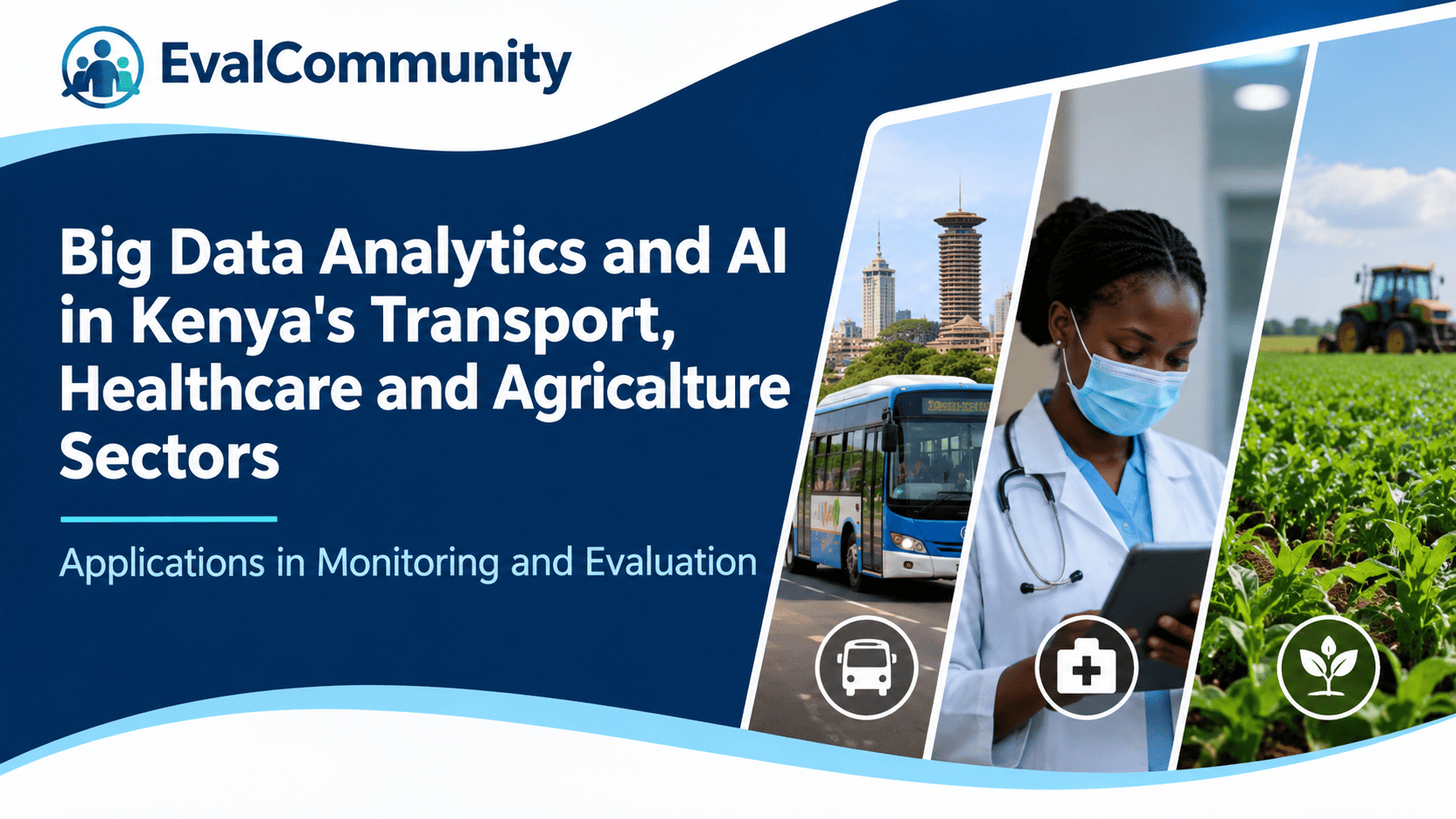
Big Data Analytics and AI in Kenya
Integrating Big Data Analytics and Artificial Intelligence into Monitoring and Evaluation in a Fast-Changing Development Landscape
Examining the application of Big Data Analytics and AI in Kenya’s transport, healthcare and agricultural sectors.
Original Publication and Attribution
Original title: Integrating Big Data Analytics and Artificial Intelligence into Monitoring and Evaluation in a Fast-Changing Development Landscape
Author: Bernard Okpe
Author affiliation: Nigeria Country Department, African Development Bank (AfDB)
Publication: eVALUation Matters, Second Quarter 2020
Original article: Pages 34–41 of the publication.
This educational case study has been prepared by EvalCommunity Academy based on the original article. It is an independent learning resource and is not an official publication of the African Development Bank.
1. Introduction: Big Data and AI in a Changing M&E Landscape
The fourth industrial revolution (4IR) and advances in information technology have created vast quantities of digital data generated in real time and in different formats.
According to Bernard Okpe’s article, Big Data Analytics and Artificial Intelligence are contributing to changes in Monitoring and Evaluation by increasing efficiency, reducing evaluation costs and creating new possibilities for development monitoring and assessment.
These technologies are also supporting:
- Deeper citizen participation in decision-making.
- Greater access to data and information.
- Improved transparency and accountability.
- Predictive modelling and large-scale forecasting.
- More effective monitoring of development operations.
Central Argument of the Article
Big Data Analytics and Artificial Intelligence are important technologies for the future of Monitoring and Evaluation because they offer new ways to collect, analyse and use information to support development decisions.
2. Three Key Messages
Citizen Participation
Digital technologies create platforms that deepen citizen participation and improve access to information, transparency and accountability.
Predictive Capabilities
Big Data and AI support predictive modelling and large-scale forecasting for development operations.
Sustainable Development
These technologies can contribute to achieving key indicators under the 2030 Agenda for Sustainable Development.
Source: Okpe, eVALUation Matters, Second Quarter 2020, page 35.
3. Understanding Big Data Analytics and Artificial Intelligence
Big Data Analytics
The article describes Big Data in terms of the large volume of digital data generated daily through digital services, technologies and tools, together with methods used to analyse large datasets.
It highlights how information generated through different sources can be analysed to support decision-making and provide insights into development interventions.
Artificial Intelligence
The article describes AI as a branch of computer science that facilitates the development of machines capable of performing tasks requiring human intelligence.
It also explains that AI systems analyse data and adjust to new inputs, allowing technologies to be designed for specific interventions.
The Relationship Between Big Data and AI
According to the article, Big Data and AI reinforce each other. AI depends on the quality of the data integrated into Big Data systems, while AI enables the analysis of large datasets to derive insights and support predictions.
An important implication for M&E
The availability of large quantities of data does not automatically produce useful evaluation evidence. The article emphasises the importance of quality data as the foundation for meaningful strategies, policymaking, resource allocation and public service delivery.
Source: Okpe, pages 35–36.
4. Application of AI and Big Data in Kenya
The article examines three sectors in Kenya to illustrate how Big Data Analytics and AI are influencing monitoring, evaluation and service delivery: transport, healthcare and agriculture.
4.1 Transport Sector: Ridesharing Applications

Illustrative image of an urban transport environment. The article’s example concerns Kenya.
The article discusses the use of data generated through taxi-hailing applications such as Uber, Taxify and Little Cab in Kenya’s transport sector.
These applications generate information about people’s travel patterns and the use of transport services.
How the Technology Works
According to the article, the system collects and analyses several types of information:
- Location data from mobile phones.
- Information about frequently used roads.
- Travel patterns at different times of the day.
- Geolocation information from vehicles.
- News reports, blogs and social media posts concerning traffic conditions.
These sources contribute to a database that can be used to identify road conditions and traffic congestion patterns.
Implications for Monitoring and Evaluation
The article identifies several implications of this approach:
- Travellers can access information that helps drivers select alternative routes during periods of congestion.
- Government authorities can obtain information about the most congested roads.
- Decision-makers can use this information when considering road network improvements.
- Big Data can complement conventional evaluation methodologies by providing timely, longitudinal and easily analysable information.
- Information about road conditions can support decisions concerning road infrastructure development.
M&E lesson from the transport example
Digital information generated through everyday transport activities can complement traditional M&E data sources and provide additional information for monitoring transport systems and infrastructure.
Source: Okpe, pages 37–38.
4.2 Healthcare Sector: AI-Powered Digital Healthcare Assistant

Illustrative healthcare technology image.
The article discusses the application of AI in Kenya’s healthcare sector through Dr. Elsa, described as a data-powered AI healthcare assistant intended to improve affordable and high-quality access to healthcare.
At the time covered by the article, its application was described as being in the early stages in Kenya.
Applications Described in the Article
- Supporting clinical decision-making.
- Assisting with the diagnosis of patients.
- Supporting electronic health records.
- Providing information to assist healthcare practitioners in clinical decisions.
- Supporting patient self-diagnosis based on symptoms.
Data Sources
The article explains that AI systems in healthcare can use information from several sources, including:
- Electronic health records.
- Information about diseases and patient symptoms.
- Prescribed medications.
- Treatment outcomes.
- Laboratory testing and diagnostic information.
Combining and analysing these different sources can help identify relationships between symptoms, treatments and outcomes.
Implications for Monitoring and Evaluation
The article highlights the potential of Big Data and AI to support:
- Monitoring and evaluation of therapeutic techniques.
- Assessment of the effectiveness of medicines and treatment procedures.
- Identification of anomalies in diagnosis.
- Mapping areas that may be prone to particular diseases.
- Faster and more targeted public health responses.
M&E lesson from the healthcare example
Combining healthcare information from multiple sources can create opportunities for monitoring treatment outcomes, evaluating healthcare interventions and supporting service delivery.
Source: Okpe, page 38.
4.3 Agricultural Sector: Drones and Agricultural Monitoring

Illustrative agricultural landscape.
The article describes the use of drones in Kenya’s agricultural sector and their potential contribution to agricultural production, monitoring and evaluation.
Drones can provide information about:
- Soil quality.
- The presence of pests.
- Nutrient deficiencies.
- The extent of farm coverage.
- The condition of crops and soils across large areas.
Data Sources and Collection
The article identifies several sources of agricultural information used in connection with drone technology:
- Smartphone applications.
- Social media posts from farmers regarding farm performance.
- News articles.
- Government agency data on soil nutrient levels.
- Agricultural market reports.
These data are used to create descriptive maps that are fed into drone GPS systems. Geolocation information helps identify areas with agricultural defects.
Implications for Monitoring and Evaluation
The article identifies several potential contributions:
- Monitoring agricultural conditions across large areas.
- Assessing the condition of crops and soils.
- Identifying pest infestations and weather-related issues.
- Supporting appropriate corrective measures.
- Reducing the time and resources required for large-scale agricultural assessment.
- Providing information that can support agricultural evaluation.
Challenges Identified
The article also identifies limitations associated with drone technology:
- Not every evaluator can afford the technology.
- Not every evaluator has the necessary capacity to operate drones.
The article suggests that adequate planning and training of M&E professionals can help address these challenges.
M&E lesson from the agriculture example
Drones can provide information about agricultural conditions over large areas, supporting more efficient monitoring and evaluation. Their application also requires appropriate resources, planning and technical capacity.
Source: Okpe, pages 38–39.
5. Comparing the Three Sector Applications
The following table summarises the applications described in the original article.
| Sector | Technology / Application | Information Used | M&E Contribution |
|---|---|---|---|
| Transport | Ridesharing applications and AI | Location, traffic, travel patterns and online information. | Traffic monitoring and road infrastructure decisions. |
| Healthcare | Dr. Elsa and AI-supported healthcare | Medical records, symptoms, prescriptions, treatment outcomes and laboratory data. | Monitoring treatment effectiveness and supporting healthcare assessment. |
| Agriculture | Drones and geolocation information | Farm information, soil data, crop conditions, social media and market reports. | Agricultural monitoring, crop assessment and identification of problems. |
6. Implications for Monitoring and Evaluation
Across the three sectors, the article demonstrates how digital technologies can complement conventional M&E approaches.
6.1 Complementing Traditional Data Sources
Big Data can provide up-to-date information and additional perspectives that complement traditional data sources, helping to create a more comprehensive outlook of a situation.
6.2 Improving Data Availability and Analysis
The article identifies the potential of Big Data to provide information that is timely, longitudinal, relatively inexpensive to obtain and easily analysable.
6.3 Supporting Decision-Making
Information generated through AI and Big Data can help decision-makers understand conditions in different sectors and inform decisions about interventions and resource allocation.
6.4 Improving Monitoring Capabilities
Digital sensors, mobile devices, online information and drones create additional opportunities to collect information and monitor changes over time and across geographical areas.
7. Opportunities and Risks of Big Data and AI in M&E
Opportunities
- Improved monitoring across different sectors.
- Greater availability of development information.
- Predictive modelling and forecasting.
- Improved productivity.
- Support for tracking development results.
- More informed policy and investment decisions.
Risks and Challenges
- Safety of personal information.
- Ethical issues associated with collecting personal data.
- Confidentiality and data governance.
- Data quality and reliability.
- Access to technological infrastructure.
- Technical capacity and training requirements.
The article stresses that sectors using these technologies need to ensure individual data are protected. It also calls for transparent consideration of risks and clear communication of safeguards concerning confidentiality and data governance.
Source: Okpe, page 40.
8. Conclusion and Lessons for M&E Professionals
The article concludes that countries across Africa require investment in critical sectors such as education, technology, healthcare, agriculture and transport. Better investment decisions require quality data.
It argues that M&E is evolving and becoming increasingly equipped with technologies that can support development interventions and results.
Its recommendations and observations highlight the importance of:
- Utilising Big Data and AI opportunities in M&E.
- Developing appropriate infrastructure to leverage these technologies.
- Protecting personal information and addressing ethical data collection concerns.
- Ensuring confidentiality and appropriate data governance.
- Maintaining data quality standards to improve reliability and consistency.
- Sensitising policymakers on the use of Big Data and AI results in policy development.
A Key Message from the Article
The quality standards used in traditional data collection should also be applied when using Big Data for Monitoring and Evaluation, to improve the reliability and consistency of information.
9. Knowledge Assessment
Test your understanding of the article. The following questions are developed by EvalCommunity Academy using information presented in the original publication.
QUESTION 1
Which three sectors in Kenya are discussed in the article?
A. Education, energy and banking.
B. Transport, healthcare and agriculture.
C. Tourism, manufacturing and education.
D. Finance, telecommunications and housing.
Reveal answer
Correct answer: B. The article discusses applications in transport, healthcare and agriculture in Kenya.
QUESTION 2
What information is used by ridesharing applications in the transport example?
A. Only traditional road inspection reports.
B. Location information, travel patterns, road usage and online information.
C. Only population census data.
D. Only government expenditure reports.
Reveal answer
Correct answer: B. The article describes location data, information about frequently used roads, geolocation and online information such as news and social media.
QUESTION 3
What is Dr. Elsa in the healthcare example?
A. An agricultural drone.
B. A road traffic monitoring application.
C. A data-powered AI healthcare assistant.
D. A government financial management system.
Reveal answer
Correct answer: C. The article describes Dr. Elsa as a data-powered AI healthcare assistant intended to improve affordable and high-quality access to healthcare.
QUESTION 4
What information can agricultural drones help provide?
A. Soil quality, pests, nutrient deficiencies and crop conditions.
B. Only agricultural market prices.
C. Only farmer registration information.
D. Only government agricultural budgets.
Reveal answer
Correct answer: A. These are among the agricultural applications described in the article.
QUESTION 5
Which challenge associated with drones does the article identify?
A. Drones cannot collect agricultural information.
B. Not every evaluator can afford or has the capacity to operate drones.
C. Drones cannot cover large areas.
D. Drones cannot use geolocation information.
Reveal answer
Correct answer: B. The article identifies affordability and evaluator capacity as challenges, suggesting planning and training as ways to address them.
QUESTION 6
What does the article identify as an important requirement for using Big Data in M&E?
A. Replacing all traditional data collection methods.
B. Eliminating all manual evaluation activities.
C. Applying the same quality standards used in data collection to improve reliability and consistency.
D. Using the largest possible dataset regardless of quality.
Reveal answer
Correct answer: C. The article explicitly recommends applying data quality standards to Big Data used in M&E.
10. Reflection Questions for M&E Professionals
Consider the following questions in relation to the applications described in the article:
- How can Big Data complement traditional monitoring and evaluation data sources?
- What opportunities do mobile applications and geolocation information create for transport monitoring?
- How can AI-supported healthcare information contribute to monitoring treatment outcomes?
- What types of agricultural information can drones provide to M&E professionals?
- What infrastructure and technical capacity are required to integrate these technologies into M&E systems?
- How can organisations protect personal information when collecting and analysing Big Data?
- Why is data quality important when using AI and Big Data for development decisions?
11. Practical Learning Assignment
Assignment: Examine the Application of Big Data and AI in One Development Sector
Using the three sector examples described in the original article, select one of the following:
- Transport and ridesharing applications.
- Healthcare and the Dr. Elsa application.
- Agriculture and drone technology.
Prepare a short analytical brief addressing:
- What data sources are identified in the selected sector?
- How are Big Data or AI technologies applied?
- What potential contributions to monitoring and evaluation are described?
- What limitations or risks does the article identify?
- What infrastructure, capacity and data governance considerations are relevant according to the article?
Expected deliverable
A two-page analytical brief based on the selected sector and the information presented in the original article. Clearly distinguish information documented in the publication from your own reflections.
12. Original Article and References
Primary source
Okpe, B. (2020). Integrating Big Data Analytics and Artificial Intelligence into Monitoring and Evaluation in a Fast-Changing Development Landscape. eVALUation Matters, Second Quarter 2020.
Original article pages: 34–41.
The original article includes references to research and publications by UN Global Pulse, UNDP, McKinsey, Raftree and Bamberger, and other authors. These references are retained as cited in the original publication and have not been independently updated or verified for this case study.
Develop Your AI Skills in Monitoring and Evaluation
Explore professional learning opportunities in Artificial Intelligence, Big Data Analytics and emerging technologies for Monitoring and Evaluation and International Development.
EXPLORE EVALCOMMUNITY ACADEMY COURSES →
Learn. Apply. Evaluate. Make a greater impact.
