
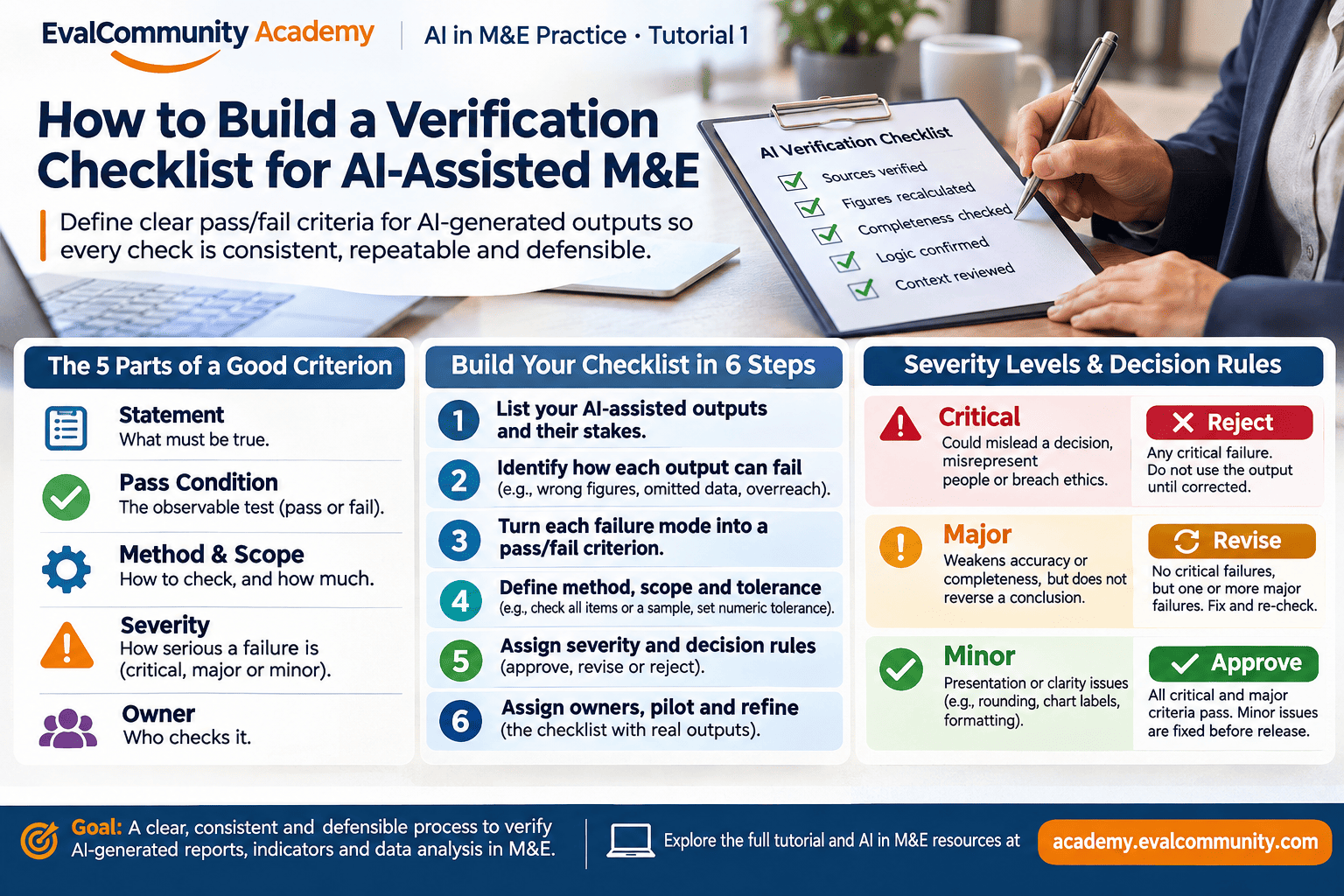
Verification Checklist for AI-Assisted M&E
EvalCommunity Academy · AI Verification Series · Tutorial 1
How to Build a Verification Checklist for AI-Assisted M&E
Learn how to define clear pass/fail criteria for AI-generated outputs, including reports, indicators and data analysis, so every check is consistent, repeatable and defensible.
Level: Intermediate · Reading time: about 10 minutes · Updated: November 2026
Learning objectives
By the end of this tutorial you will be able to:
- Explain why vague “check it” instructions fail and pass/fail criteria work.
- Write verification criteria that are specific, observable and binary.
- Assign severity levels and decision rules to approve, revise or reject an output.
- Adapt ready-made checklists for reports, indicators and data analysis.
- Pilot and refine a checklist for your own team or assignment.
1. Why you need pass/fail criteria
Most teams that use AI already tell staff to “check the output”. The problem is that “check” means something different to everyone. One person skims for typos, another reruns every calculation, a third trusts anything that looks professional. The result is inconsistent quality and no record of what was actually verified.
A verification checklist with pass/fail criteria fixes this. Each criterion states exactly what must be true for the output to pass, how to check it, and what happens if it fails. Two reviewers using the same checklist should reach the same verdict.
Vague instruction
- “Check the figures are correct”
- “Make sure quotes are accurate”
- Result depends on who checks
Pass/fail criterion
- “All headline figures reproduced from raw data within ±0.5 points”
- “Every quote found verbatim in a named transcript”
- Same verdict whoever checks
2. Anatomy of a good criterion
Every criterion in your checklist should have five parts. If any part is missing, reviewers will fill the gap with their own judgement, and consistency is lost.
The SOBER test for every criterion
- Specific: names exactly what is checked.
- Observable: can be confirmed by looking at evidence, not opinion.
- Binary: the answer is pass or fail, not “mostly”.
- Evidence-linked: points to the source used to check it.
- Realistic: can be done in the time available.
3. Build your checklist in six steps
1
List your AI-assisted outputs and their stakes
Write down every output where AI plays a role: desk review summaries, indicator updates, coded interview data, report drafts. Mark each as low, medium or high stakes. High-stakes outputs (donor reports, evaluation findings, published figures) need the fullest checklist.
2
Identify how each output can fail
For each output, list the failure modes: fabricated quotes, wrong denominators, missing districts, overstated causal claims. Ask past reviewers what errors they have caught. You can also ask AI to brainstorm failure modes, then judge the list yourself.
I use AI to draft quarterly indicator summaries from our Indicator Tracking Table. List the ways this output could be wrong or misleading, grouped by source, calculation, completeness and interpretation.
3
Turn each failure mode into a pass/fail criterion
Flip each failure into a positive statement with a test. “Figures might be wrong” becomes “Headline figures reproduced from raw data within ±0.5 percentage points”. Apply the SOBER test to every line.
Failure mode: totals don’t match subgroups
Criterion: sum of disaggregated values equals the reported total for every indicator
4
Define method, scope and tolerance
For each criterion, say how to check it and how much to check. Decide whether you check all items or a sample (for example, 10 quotes or 20% of figures, whichever is larger). Where numbers are involved, set a tolerance for rounding so reviewers don’t argue over 0.1.
5
Assign severity and decision rules
Label each criterion critical, major or minor, and agree in advance what each result means for the output. Section 4 gives a ready-made set of rules.
6
Assign owners, pilot and refine
Name who checks each criterion, ideally someone other than the person who ran the AI task. Pilot the checklist on two or three real outputs. Where two reviewers disagree, rewrite the criterion until they don’t. Review the checklist at the end of each assignment or quarter.
4. Severity levels and decision rules
Severity turns a list of checks into a decision. Agree these rules before you start reviewing, not after you find a problem.
CRITICAL
The error could mislead a decision, misrepresent people or breach ethics. Examples: fabricated quote, wrong headline figure, identifiable data exposed.
MAJOR
The error weakens accuracy or completeness but does not reverse a conclusion. Examples: a missing caveat, one district omitted from a summary.
MINOR
Presentation or clarity issues. Examples: inconsistent rounding, unclear chart label, formatting.
5. Ready-made checklists to adapt
Use these as starting points. Adjust tolerances, sample sizes and owners to your context, and remove criteria that don’t apply.
A. Evaluation reports and report sections
B. Indicators and indicator reporting
C. Data analysis (quantitative and qualitative)
The thresholds above (±0.5 points, 80% agreement, 150% of target) are suggested starting points, not standards. Set your own with your team or client and record them in the checklist.
6. Worked example: an AI-drafted quarterly indicator summary
The output: a MEAL officer uses AI to draft a two-page Q3 summary from the Indicator Tracking Table. A colleague reviews it with checklist B.
I1 passes. All five outcome indicators match the recalculation within tolerance.
I2 passes. Definitions match the indicator reference sheets.
I3 fails (major). Female and male participants sum to 1,240, but the total shows 1,310. The AI included 70 records with sex not recorded without saying so.
I4 fails (major). The text says literacy “increased by 15%”, but it rose from 40% to 55%: 15 percentage points, a 37.5% relative increase.
I5 passes. The one value above 150% of target is explained.
Decision: Revise. No critical failures, two major ones. The officer adds a “sex not recorded” row, corrects the wording to “15 percentage points”, and the reviewer re-checks I3 and I4 only. Both pass, and the summary is approved.
7. Copy-ready checklist template
Paste this into a document or spreadsheet and fill one block per criterion. Keep the completed checklist with your verification log.
AI VERIFICATION CHECKLIST
Output: [name and version]
AI tool and task: [tool / what it did]
Stakes: [low / medium / high]
Reviewer: [name, not the AI operator] · Date: [date]
ID: [e.g. I1]
Criterion: [what must be true]
Pass if: [observable test and tolerance]
Method and scope: [how / all or sample size]
Severity: [critical / major / minor]
Result: [pass / fail] · Notes: [what was found]
DECISION: [approve / revise / reject]
Re-check completed: [date / reviewer]
8. Common mistakes to avoid
9. Your action plan
Tick off each step as you build your first checklist.
10. Knowledge check
Tap each question to reveal the answer.
1. Is “the analysis is robust” a good criterion?
No. It is not observable or binary. A better version: “a second analyst reproduces the headline results from the same data using the documented steps.”
2. What are the five parts of a criterion?
Statement, pass condition, method and scope, severity, and owner.
3. One critical criterion fails and everything else passes. What is the decision?
Reject. Any critical failure means the output is not used until it is corrected and fully re-checked.
4. Why set severity before reviewing?
So that nobody is tempted to downgrade an error once it has been found, especially close to a deadline.
5. Literacy rose from 40% to 55%. The AI wrote “increased by 15%”. Pass or fail?
Fail. It is a 15 percentage-point increase, which is a 37.5% relative increase. The text must say which it means.
6. Two reviewers reach different verdicts on the same criterion. What should you do?
Rewrite the criterion. Disagreement shows it is not specific or observable enough. A good criterion gives the same verdict whoever checks.
11. Key takeaways
- “Check the output” is not a method. Pass/fail criteria make verification consistent and defensible.
- Every criterion needs a statement, pass condition, method and scope, severity and owner.
- Set severity and decision rules in advance: any critical failure means reject.
- Keep checklists short, focused on the errors that matter, and checked by someone other than the AI operator.
- Pilot, compare reviewers’ verdicts, and refine until the checklist gives the same answer whoever uses it.
Continue the AI Verification Series
Explore more EvalCommunity Academy tutorials on using AI responsibly in monitoring, evaluation, accountability and learning.
Thresholds and examples in this tutorial are illustrative starting points, not official standards. Adapt them to your organisation’s policies, your client’s requirements and the evaluation standards that apply to your work.
