
HungerMap WFP
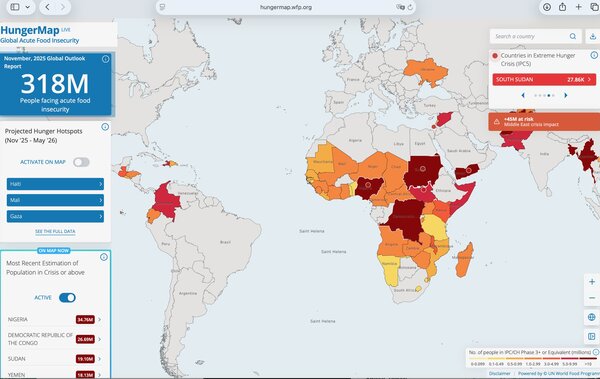
HungerMap Live: Using AI-Assisted Forecasting and Predictive Modelling to Turn Food Security Data into Early Action
A WFP case study on how a modernized intelligence platform combines food security data, monitoring, analysis and predictive modelling to help identify where hunger is growing and where urgent attention may be needed.
Case Study at a Glance
| Organization | United Nations World Food Programme (WFP) |
| Solution | HungerMap Live |
| Primary purpose | Food security monitoring, analysis and forecasting |
| AI / advanced analytics role | Predictive modelling and AI-assisted forecasting |
| Geographic scope | More than 50 countries |
| Key information sources | IPC data, government-validated statistics, climate, market, agricultural and economic data, plus WFP analysis |
1. About the Organization
The United Nations World Food Programme (WFP) is using HungerMap Live as part of its food security monitoring and intelligence capabilities.
According to WFP, the platform brings together information from its network of more than 300 food security analysts with information from dozens of trusted partners.
The purpose is to provide a more complete and updated picture of hunger and food security conditions in vulnerable countries and to support decisions about where urgent attention may be required.
2. The Challenge
Food security conditions can change rapidly, while humanitarian organizations operate in an environment of increasing needs and limited funding.
WFP describes the need for timely, trusted and evidence-based information that can help identify emerging food security problems before they become more severe.
The information challenge: decision-makers need to understand not only the current state of food security, but also where conditions may deteriorate and what factors are contributing to food security needs.
WFP also reports that funding for global food security monitoring and analysis has declined, with its data footprint shrinking by 25 percent in the past year.
Against this context, WFP released a modernized version of HungerMap Live designed to bring multiple sources of food security information and predictive modelling together in one intelligence platform.
3. The Solution: HungerMap Live
HungerMap Live is WFP’s next-generation digital monitoring and intelligence platform for food security.
WFP describes the platform as integrating a wide range of food security data and analysis with predictive modelling. It is designed to provide a current picture of food security conditions while also supporting forecasting of projected food needs.
The platform is currently described by WFP as supporting food security intelligence in more than 50 countries.
4. How the Intelligence Platform Works
WFP describes HungerMap Live as bringing together multiple categories of information rather than relying on a single dataset.
The platform incorporates food security information, including data associated with the Integrated Food Security Phase Classification (IPC).
WFP combines government-validated statistics with information from dozens of trusted partners.
Climate, market, agricultural and economic information contributes to the food security intelligence picture.
Predictive modelling is used to support analysis of food security conditions and projected food needs.
The resulting intelligence is intended to help identify countries and regions requiring urgent attention and understand factors contributing to food security needs.
5. Where AI Enters the Process
In the WFP description, AI is specifically associated with AI-assisted forecasting and predictive modelling.
The AI-assisted forecasting capability is applied to WFP-designated Hunger Hotspots, described in the source as 16 countries where populations are already experiencing catastrophic hunger.
The three questions the platform is designed to help answer
- What is the current state of food security?
- Which countries and regions require urgent attention?
- What are the underlying factors contributing to food security needs?
Importantly, the source does not describe AI as replacing WFP’s food security analysts. Instead, WFP explicitly describes the platform as bringing together information from its network of more than 300 analysts with information from external partners and multiple data sources.
6. Adding a Nutrition Dimension
HungerMap Live also includes a specialized layer focused on micronutrient intake adequacy.
According to WFP, this layer connects food security conditions with the nutritional quality of diets and is intended to help identify populations at risk of “hidden hunger” associated with inadequate intake of essential vitamins and minerals.
WFP states that this nutrition analysis was developed with support from the Gates Foundation.
7. From Monitoring to Early Action
The central idea behind HungerMap Live is not simply to visualize food security information. WFP positions the platform as an intelligence capability intended to support action before food security conditions become more severe.
The platform provides AI-assisted forecasting of projected food needs in WFP-designated Hunger Hotspots. This creates a connection between monitoring, forecasting and anticipatory action.
WFP reports that its experience with anticipatory action programmes shows that every dollar invested in these programmes has generated a minimum of seven dollars in savings.
Source note: The $1-to-$7 figure is reported by WFP in the source article. The article does not provide the methodology or underlying study details for this figure, so this case study does not independently calculate or validate the estimate.
8. Why This Case Matters for Monitoring & Evaluation Professionals
HungerMap Live is primarily presented by WFP as a food security monitoring and intelligence platform. The source does not describe it as an M&E system.
However, the case is highly relevant to M&E because it illustrates how monitoring can evolve from describing current conditions toward supporting forward-looking analysis and early action.
Monitoring
Multiple sources of food security information are brought together to provide an updated picture of conditions.
Data Integration
Food security, climate, market, agricultural and economic information contribute to a broader analytical picture.
Forecasting
Predictive modelling and AI-assisted forecasting extend the analytical function beyond describing current conditions.
Decision Support
The platform is intended to help identify areas requiring urgent attention and understand contributing factors.
9. What M&E Professionals Can Learn from the Case
The HungerMap Live case illustrates several important concepts for professionals working with monitoring, evidence and data.
- AI does not have to replace monitoring systems.
AI can be incorporated into an existing analytical ecosystem to support forecasting and interpretation. - Data integration is central to AI-enabled monitoring.
The WFP approach combines different categories of information rather than treating one dataset as sufficient for understanding food security. - Forecasting can extend the value of monitoring.
Monitoring can provide information about current conditions, while predictive modelling can support analysis of what may happen next. - Context matters.
Climate, markets, agriculture and economic conditions are considered alongside food security information. - Evidence needs to remain connected to decisions.
The stated purpose of the platform is not simply to produce data, but to help identify areas requiring attention and support action.
10. What We Still Do Not Know from the Published Case
To avoid overstating the evidence, several important technical and evaluation questions are not answered in the source article.
- The article does not provide the specific predictive model architecture.
- It does not specify which AI models or algorithms are used for the AI-assisted forecasting.
- It does not provide model accuracy, precision, recall or other predictive-performance metrics.
- It does not provide a detailed description of model validation or testing procedures.
- It does not quantify how many decisions or interventions have been directly triggered by HungerMap Live.
- It does not provide a detailed evaluation of the platform’s impact compared with previous monitoring approaches.
Why this matters: these gaps should not be filled with assumptions. A credible AI case study should distinguish between what an organization reports about its system and what has been independently demonstrated through evaluation.
Key Takeaway
HungerMap Live demonstrates how an international humanitarian organization can combine large-scale food security monitoring, multiple data sources, predictive modelling and AI-assisted forecasting to move toward more forward-looking intelligence. The WFP case is particularly relevant to M&E professionals because it illustrates the connection between data → monitoring → analysis → forecasting → decision support → early action.
Source
World Food Programme (WFP),
“WFP Releases HungerMap Live; a Modernized Intelligence Platform that Turns Data on Global Hunger into Early Action.”
Read the full WFP article →
Visit HungerMap Live →
This case study is based on information publicly described by WFP in the cited source. Additional technical or impact claims have not been added where they are not supported by the source.
